
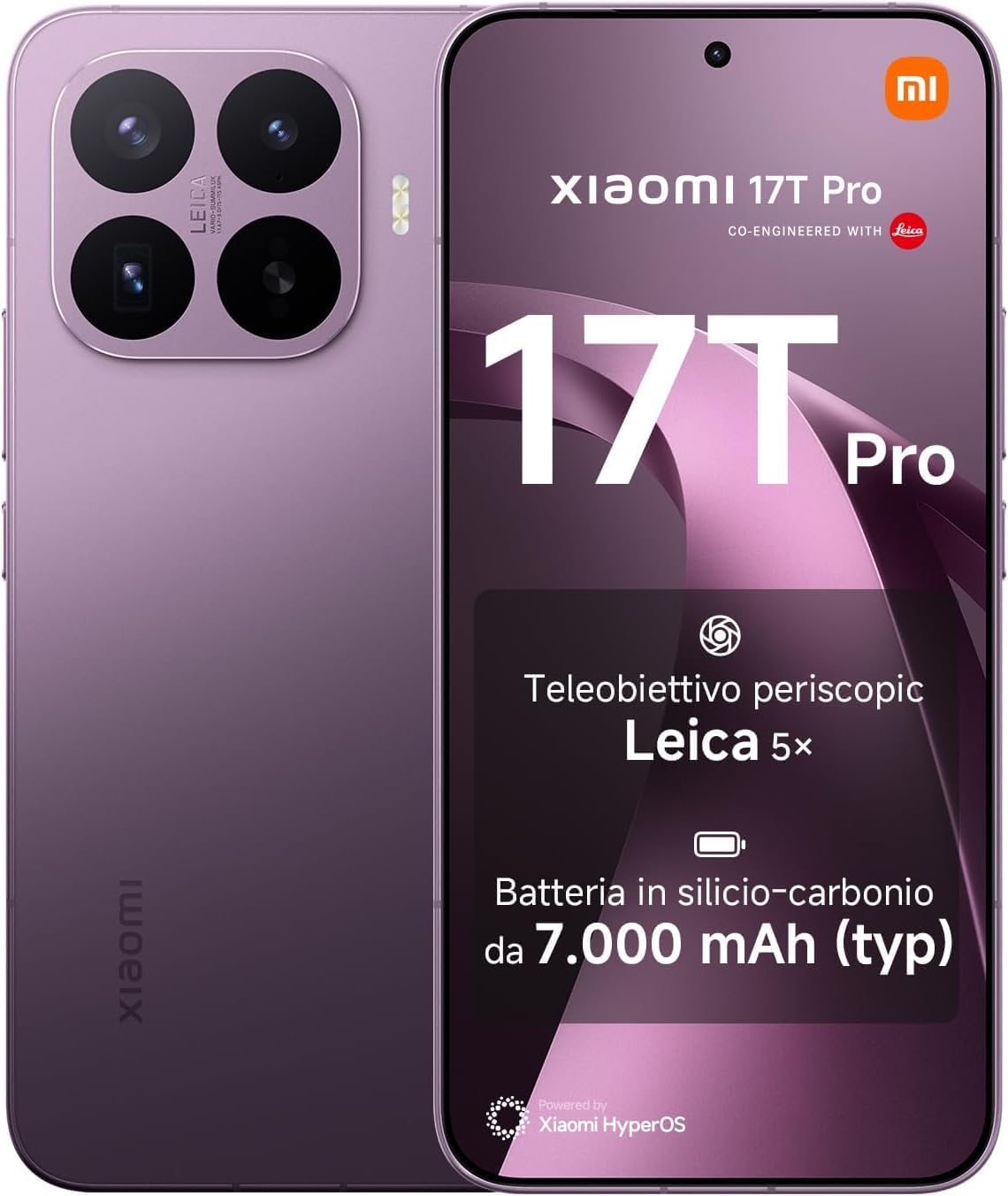

Price: $777.50
(as of 2026-11-04 05:54 GMT+0000 – Details)

Network Compatibility and SIM Configuration
The device is marketed as an international model that operates on T‑Mobile, Mint Mobile, and Tello networks in the United States, while explicitly stating it will not work on Verizon, Sprint, Boost, MetroPCS, AT&T, or Cricket. It supports dual‑nano SIM cards with 5G SA and NSA across a very extensive list of bands (including n1, n3, n5, n7, n8, n20, n28, n38, n40, n41, n48, n66, n75, n77, n78) and a full complement of LTE FDD and TDD bands, plus UMTS and GSM fallback. An eSIM is also available, but there is no micro‑SD slot for storage expansion. For users on the supported carriers this provides broad 5G coverage worldwide; however, the carrier restriction in the US limits its practicality for anyone on the excluded networks.
Leica‑Branded Triple Camera System
The rear array consists of a 23 mm Leica Summilux main sensor (50 MP, Light Fusion 950, 2.4 µm 4‑in‑1 pixel, f/1.67, OIS), a 115 mm periscope telephoto (50 MP, f/3.0, OIS, 5× optical zoom) and a 15 mm ultra‑wide (12 MP, f/2.2, 120° FOV). The lens group uses a 1G+6P glass‑plastic hybrid with multi‑coating to reduce flare and haze. Video recording reaches 8K at 30 fps, 4K at 120 fps, and offers Log capture up to 4K 60 fps, plus high‑frame‑rate slow‑motion up to 1920 fps at 720p. AI Ultra Zoom extends digital reach to 120×, while Leica Portrait and Master Portrait modes add real‑time bokeh at 4K 60 fps. The system is strong on paper, but real‑world low‑light performance and processing latency depend on the ISP implementation, which is not detailed in the spec sheet.
Display Characteristics and Eye‑Care Certifications
The 6.83‑inch AMOLED panel uses a 1.5K (2772 × 1280) resolution at 447 PPI, supports up to 144 Hz refresh with a 480 Hz touch sampling rate (3500 Hz instantaneous), and covers 100 % DCI‑P3 with 12‑bit color depth (68 billion colors). Typical brightness is 600 nits, high‑brightness mode reaches 2000 nits, and a peak of 3500 nits is claimed at 25 % APL. The screen is protected by Corning Gorilla Glass 7i and features DC dimming, Original Color PRO, Pro HDR, Wet Touch Technology 2.0, and multiple TÜV Rheinland certifications for low blue light, flicker‑free, circadian‑friendly, and intelligent eye care. These specs suggest a very bright, color‑accurate panel suitable for HDR content, though the actual sustained brightness under load and the effectiveness of the eye‑care modes in daily use are not independently verified.
Processing Platform, Memory and Storage
The handset runs on the MediaTek Dimensity 9500 built on a 3 nm process, featuring an 1 + 3 + 4 core CPU layout (C1‑Ultra up to 4.21 GHz, three C1‑Premium up to 3.5 GHz, four C1‑Pro up to 2.7 GHz) and a Mali G1‑Ultra GPU. An NPU 990 handles AI workloads such as the on‑device interpreter, note summarisation, and image editing. The configuration ships with 12 GB of LPDDR5X RAM and 512 GB of UFS 4.0 storage, with no expandable memory. This hardware tier places the phone in the flagship performance bracket for 2024‑2025, capable of heavy multitasking and high‑end gaming, but actual thermal throttling behavior and sustained GPU clocks are not disclosed.
Battery Capacity, Charging Speeds and Power Features
A 7000 mAh silicon‑carbon cell provides a large energy reserve, complemented by 100 W wired HyperCharge, 50 W wireless HyperCharge, and support for 100 W PPS and 22.5 W wired reverse charging. The device also complies with PD 3.0/2.0 for broader charger compatibility. In theory, the wired solution can replenish the battery from empty to full in roughly 20 minutes, while wireless charging remains fast for a phone of this capacity. Reverse charging enables powering accessories such as earbuds or a smartwatch. The silicon‑carbon chemistry promises higher energy density and better longevity than conventional lithium‑ion, yet long‑term cycle life and real‑world charge‑time under varying temperatures are not provided.
Software AI Suite, Biometrics, Sensors and Build
The software layer adds a suite of Google‑integrated AI tools: Circle to Search, Gemini, AI Interpreter, AI Notes, AI Recorder, AI Subtitles, AI Film, AI image editing, AI Portrait, AI Writing, AI Speech Recognition, AI Dynamic Wallpapers, and an AI Creativity Assistant. Security options include an in‑screen fingerprint sensor and AI face unlock. Navigation uses multi‑constellation GNSS (GPS L1+L5, Galileo E1+E5a, GLONASS G1, BeiDou, QZSS L1+L5, NavIC L5) with A‑GPS. The sensor array covers proximity, ambient light, accelerometer, gyroscope, electronic compass, IR blaster, flicker sensor, X‑axis linear motor, and color‑temperature sensor. The chassis employs a flat aluminium‑alloy frame with 1.29 mm bezels on all sides via LIPO packaging, aiming for a premium feel and slim profile. While the feature list is extensive, the actual responsiveness of the AI services and the durability of the ultra‑thin bezels under drop stress are not documented.